
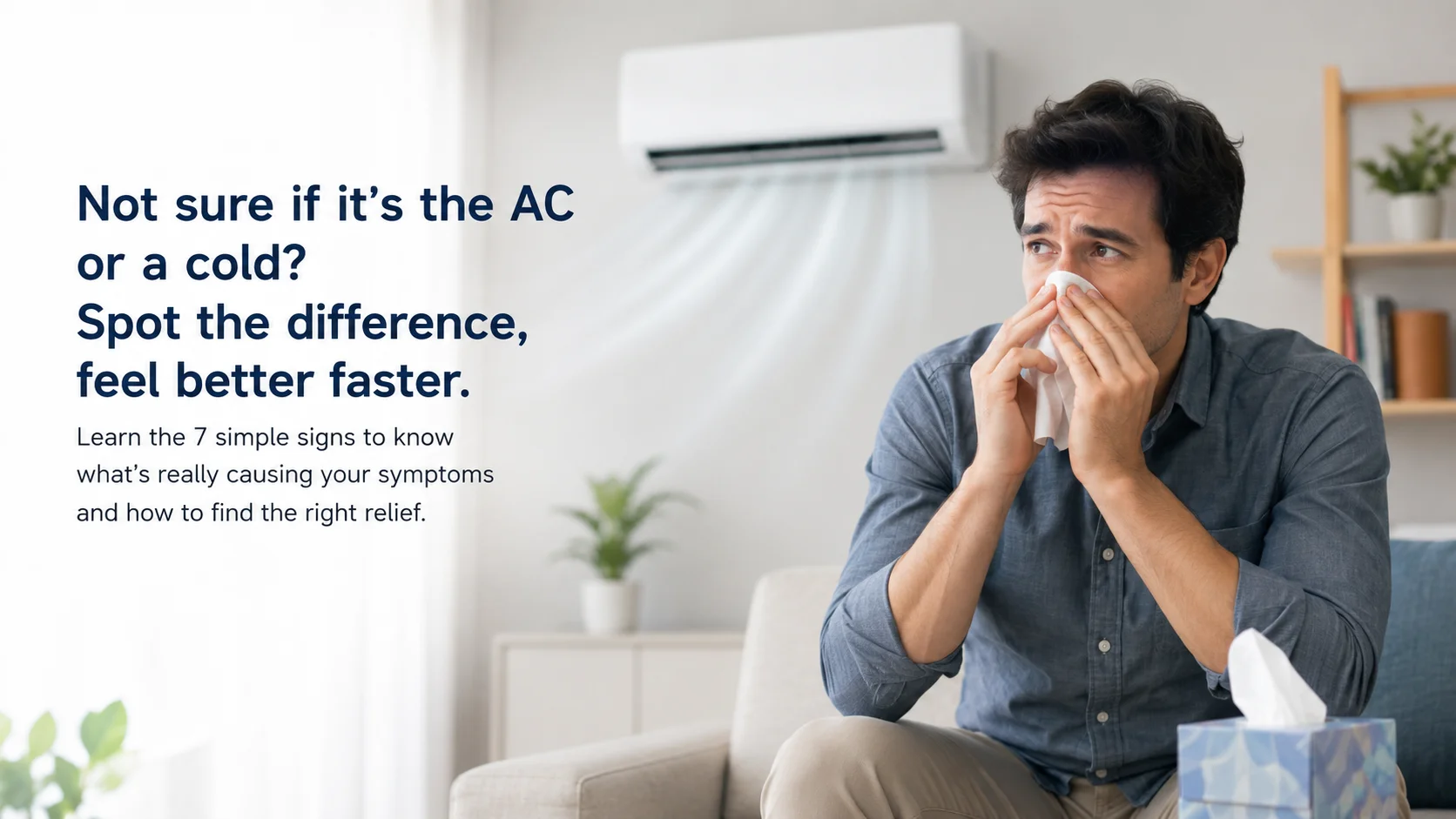
Not sure if the air conditioning is behind your sneezing or if you’ve caught a cold? Here’s the quickest test: AC symptoms fade when you leave the room, but a cold stays with you wherever you go.
Air conditioning doesn’t give you a cold. It blows around dust and mold, and it dries out the air. This can make your nose run and your eyes itch. A cold is different. It’s a virus you catch from other people. It creeps up over a day or two and usually clears in about a week.
The two can feel almost the same. But small clues tell them apart, like a fever, itchy eyes, or how long you’ve felt this way. Below are seven simple signs to help you spot the difference and to know when it’s time to see a doctor. This guide from Call Doctor Now walks you through each one in plain language.
What Is an “AC Allergy”?
An “AC allergy” is not an allergy to the air conditioner itself. It is an allergic or irritant reaction to what the AC does to the air around you. In medical terms, it is a form of rhinitis — inflammation of the nose — set off by cooled indoor air.
You cannot be allergic to a machine. You can react to what the machine carries into the room and to how it changes the air. That is the difference this whole guide rests on.
How air conditioning triggers allergy-like symptoms
Air conditioning affects your nose in two separate ways. One involves allergens. The other involves dry air. Both can cause sneezing, a blocked nose, and watery eyes, so people often lump them together as an “AC allergy.”
Dust mites and mould inside AC systems
Air conditioners move a lot of air, and that air is not always clean. Dust, pet dander, and tiny particles collect in the filters and ducts. When the unit switches on, some of these particles blow back into the room. If you are sensitive to them, your immune system reacts and releases histamine. Histamine causes the sneezing and itching of allergic rhinitis.
Mold is the second problem, and it hides in a specific place. The cold parts of an AC unit collect moisture, and damp, dark spaces are where mold grows. Mold spores enter homes through ventilation systems and only need the right damp conditions to start multiplying. Breathing in these spores can trigger the same allergy symptoms, and sometimes a cough or wheeze.
One point is often reported incorrectly. Air conditioning does not “breed” dust mites in the room air. Dust mites need humidity above roughly 50 percent to thrive, and air conditioning actually helps control indoor moisture. The mites and their droppings that already live in bedding, sofas, and carpets are simply stirred up and circulated. So the AC spreads existing allergens rather than creating them.
Cold, dry air and non-allergic rhinitis
Sometimes there is no allergen at all. The cold, dry air alone is enough to irritate your nose. Doctors call this non-allergic, or vasomotor, rhinitis.
Air conditioners pull moisture out of the air as they cool it. Air conditioners remove water vapor, which lowers the humidity of indoor air. Dry air then dries out the lining of your nose and throat. Low humidity dries the nasal passages and increases irritation. The result feels like an allergy, a runny or blocked nose, but no immune reaction is involved. This is why some people get symptoms even in a spotlessly clean, allergen-free room.
Why AC symptoms are common in Dubai homes
Dubai’s climate keeps people indoors with the AC running for most of the year. That long exposure is exactly what makes AC-related symptoms so common here.
Outside, the air is hot and often humid. Inside, the AC runs almost constantly to keep rooms cool. Homes and offices stay sealed to hold the cold air in, so windows rarely open and fresh air rarely enters. This traps indoor particles and keeps you breathing the same recirculated air for hours.
Two things follow from this. First, any dust or mold in the system gets circulated again and again, with little fresh air to dilute it. Second, the indoor air stays dry for long stretches, which keeps irritating sensitive noses. Together they explain why many residents notice symptoms indoors that ease the moment they step outside.
What Is a Common Cold?
A common cold is a mild viral infection of the nose and throat. Unlike an AC reaction, it is caused by a virus, it spreads from person to person, and it clears on its own.
This is the core difference. An AC allergy is your body reacting to your surroundings. A cold is your body fighting an actual germ. According to the US Centers for Disease Control and Prevention (CDC), more than 200 respiratory viruses can cause colds, and rhinoviruses are the most frequent cause. When one of these viruses enters your nose or throat, your immune system goes to work — and that fight is what produces the familiar symptoms.
A cold also follows a predictable path. Symptoms build over a couple of days, peak, then fade. Cold symptoms usually peak within 2 to 3 days of infection, and most people recover in about 7 to 10 days. An allergy has no such finish line; it lasts as long as the trigger is around. That time limit is one of the most reliable ways to tell the two apart.
How colds spread indoors
Colds spread easily indoors because people are close together and breathing shared air. Air conditioning does not create the virus, but a sealed, cooled room can help it pass from one person to the next.
The virus travels in two main ways. A sore throat and runny nose are usually the first signs, and the virus passes through coughing and sneezing, so washing your hands often and not touching your face with unwashed hands lowers your risk. When someone sneezes in a closed office or living room, those droplets linger in air that is recirculated rather than replaced. Shared door handles, desks, and phones then pass the virus by touch.
This is where an AC system plays an indirect role. It does not infect you, but it moves the same air around a sealed space again and again, so an unwell colleague or family member can spread a cold more easily. Simple habits lower the risk. UAE health guidance stresses covering the mouth and nose when coughing or sneezing and washing hands regularly to limit the spread of contagious illness. You can read the official advice on the UAE Government’s communicable-diseases page.
AC Allergy vs Cold: The 7 Key Differences
Not sure which one you have? This table gives you the fast answer. The seven signs below cover cause, speed, duration, fever, itching, mucus, and location the clues doctors use to tell the two apart.
| # | Sign | AC Allergy (rhinitis) | Common Cold (virus) |
| 1 | Cause | Immune reaction to allergens, or irritation from dry air | Viral infection you catch from others |
| 2 | Onset | Fast — within minutes of exposure | Slow — builds over 1–3 days |
| 3 | Duration | As long as the trigger is around, weeks possible | Clears on its own in about 7–10 days |
| 4 | Fever | Never | Sometimes, usually mild |
| 5 | Itchiness | Common — itchy nose, eyes, throat | Rare |
| 6 | Mucus | Clear, thin, watery | May start clear, then thicken |
| 7 | Pattern | Eases when you leave the room | Stays with you everywhere |
1. Cause—immune reaction vs viral infection
The root cause is the clearest divider. A common cold is caused by a virus, while allergic rhinitis is an immune-system response to a trigger
A cold is something you catch from another person. An allergy is your body overreacting to something harmless in the air, like dust or mold. One more difference follows from this: a cold can pass to your family, but an allergy cannot. Colds are highly transmissible, while allergies are not contagious.
2. Onset—minutes vs days
Allergy symptoms arrive fast. A cold creeps up slowly. This timing is one of the easiest clues to spot.
Cold symptoms usually emerge gradually and one at a time, while allergy symptoms start quickly after exposure to the allergen. If you walk into a cold, dusty room and start sneezing within minutes, that speed points to an allergen. A cold, by contrast, might begin as a slight tickle in the throat one day and build into full congestion two days later.
3. Duration—exposure-dependent vs self-limiting
A cold has an end date. An allergy does not. This is one of the most reliable signs of all.
A cold runs its course and fades. Most people recover from a cold in about 7 to 10 days. An allergy keeps going as long as the trigger is nearby. Allergy symptoms can continue for weeks or seasons as long as exposure continues. So if you have sneezed every day for three weeks in the same air-conditioned room, a virus is unlikely to be the cause.
4. Fever—absent vs possible
Fever is a strong sign of infection. An allergy will not raise your temperature.
A cold is a viral infection and may include a sore throat, body aches, or a mild fever. An allergy involves none of these. If you have even a slight fever, the cause is far more likely to be a virus than the air conditioner. Body aches point the same way colds can cause them; allergies rarely do.
5. Itchiness—hallmark vs rare
Itching is the single most useful allergy clue. If your eyes and nose itch, think allergy first.
Allergic rhinitis often causes itching of the nose, eyes, or throat, while a common cold usually does not. Red, watery, itchy eyes are a classic sign of an allergic reaction to something in the air. If you find yourself rubbing your eyes whenever the AC is on, that itch is a signal the vents may be circulating dust or mold.
6. Mucus—clear and watery vs changing (and why colour doesn’t confirm infection)
Mucus offers a clue, but its color is widely misread. Allergy mucus tends to stay clear and watery. Cold mucus often begins clear, then thickens over a few days.
Here is the part most articles get wrong. Green mucus does not prove a bacterial infection. The color of mucus is not a dependable way to tell whether an infection is viral or bacterial, and allergies can change it too. The Mayo Clinic, Cleveland Clinic, and the CDC all confirm that green mucus does not automatically mean a bacterial infection. Judge your illness by how long it lasts and how you feel overall, not by the color alone.
7. Symptom pattern—improves away from AC vs constant
Location is the practical test, especially for anyone moving between the hot outdoors and cold indoors. An allergy follows your environment. A cold follows you.
An airway allergy becomes more likely when symptoms appear consistently on exposure to a trigger. Ask yourself a simple question: do the symptoms fade when you step outside or leave the building? If you feel fine on the weekend but blocked up every workday in an air-conditioned office, the pattern points to an allergy, not a virus.
Can Air Conditioning Actually Make You Sick?
Air conditioning does not give you a cold, and it is not an “illness” on its own. But a poorly maintained AC system can genuinely make you feel unwell through the air it circulates, the moisture it holds, and the way it seals a room off from fresh air.
The key word is maintained. A clean, well-serviced unit is not a health risk. A neglected one is a different story. Here are the three real ways AC can affect how you feel.
Dry air irritates your airways
Cooling the air also dries it out. When the lining of your nose and throat dries, it feels irritated, and a stuffy or runny nose can follow even with no germ and no allergen present. This is the non-allergic rhinitis covered earlier. It is real discomfort, but it is not an infection.
Recirculated air spreads what’s already indoors
Most AC systems cool the same air over and over instead of pulling in fresh air. In a sealed room, anything floating in that air keeps circulating. This is the idea behind “sick building syndrome,” a pattern the EPA documents in its guidance on indoor air quality.
The agency describes it clearly. Sick building syndrome occurs when building occupants experience similar symptoms after entering a particular building, with those symptoms easing or disappearing after they leave. The main cause is not the cold air itself. According to the EPA’s Indoor Air Facts sheet on sick building syndrome, inadequate ventilation, which can happen when HVAC systems do not distribute air effectively, is thought to be an important factor. In other words, the problem is stale, under-ventilated air, not air conditioning by definition.
A dirty or damp unit can breed contaminants
This is where maintenance matters most. The cold, wet parts of an AC unit, drain pans, ducts, and coils, can collect standing water, and coils can grow mold and bacteria. As the same EPA sick building syndrome guidance explains, these contaminants can breed in stagnant water that accumulates in ducts, humidifiers, and drain pans and can cause coughing, chest tightness, fever, chills, and allergic responses such as upper-respiratory congestion.
In rare cases the risk is more serious. The EPA’s indoor air quality overview notes that Legionnaires’ disease, a form of pneumonia caused by Legionella bacteria, has been linked to buildings with poorly maintained air conditioning systems. This is uncommon and specific to badly neglected systems, not everyday home units — but it is the clearest evidence that AC maintenance is a genuine health matter, not just a comfort one.
So, is it the AC making you sick?
Usually, the honest answer is that the AC is not infecting you it is either drying your airways or circulating an allergen or germ that is already in the room. A clean, well-ventilated system rarely causes problems. A dirty, sealed, under-serviced one can. If your symptoms consistently ease when you leave the air-conditioned space, that pattern points to the environment rather than a virus.
How to Reduce AC-Related Symptoms at Home
You cannot avoid air conditioning in Dubai, but you can make it easier on your body. Cleaner filters, balanced humidity, and a little fresh air remove most of the triggers behind AC-related sneezing and congestion.
The goal is simple: stop the AC from circulating allergens and stop the air from getting too dry. These steps target the causes covered earlier in this guide.
Keep filters and the unit clean
Dirty filters are the most common source of the problem because they collect the dust and mold that then blow back into the room. Cleaning or replacing them on a regular schedule cuts down what circulates. The damp parts of the unit, the drain pan, coils, and ducts, also need periodic servicing, since these are where mold and bacteria grow in standing water. A clean system is the single biggest step you can take.
Balance the humidity
Air that is too dry irritates the nose; air that is too damp feeds dust mites and mold. There is a comfortable middle range that works against both. The US Environmental Protection Agency and allergy specialists point to a target between 30 and 50 percent. The EPA recommends keeping indoor humidity below 50 percent to prevent mold growth, the same upper threshold recommended for dust mite control. Below 40 to 50 percent, dust mites struggle, while above 60 percent, they thrive.
If the AC leaves the air feeling too dry, a small amount of added moisture can help. If a room feels damp or musty, reducing moisture is the priority. The aim is that 30-to-50-percent window, not one extreme or the other.
Let in fresh air
Sealed rooms trap whatever is floating in the air. Bringing in outside air dilutes indoor allergens and stale air, which is the core fix for the “sick building” pattern. Opening windows for a short period when the outdoor heat allows, or using a system that draws in fresh air rather than only recirculating, both help. Even brief ventilation breaks the cycle of breathing the same particles for hours.
Use filtration for allergens
If dust mites or mold are your main trigger, a finer filter captures more of the tiny particles that ordinary filters miss. Health and entomology sources note that HEPA-grade filtration is effective for this. HEPA-grade filters can be fitted in a central air conditioning system or used in portable air cleaners in bedrooms and other key rooms to help remove microscopic dust mite particles that stay suspended in the air. This is most useful in the bedroom, where you spend hours breathing the same air overnight.
Reduce allergens at the source
The AC only circulates what is already in your home, so lowering the allergen load helps too. Washing bedding regularly in hot water, using allergen-proof covers on mattresses and pillows, and keeping soft furnishings clean all reduce the dust-mite reservoir that the AC would otherwise stir up. Allergen-impermeable casings for mattresses and pillows, and weekly washing of bedding in hot water, are recommended for dust-mite control.
When prevention isn’t enough
These steps reduce triggers, but they are not a diagnosis. If symptoms continue despite a clean, well-balanced environment, the cause may need a professional assessment—the next section covers when that is worth doing.
FAQs
1. How can I tell if it’s an AC allergy or a cold?
Check the pattern. AC allergy symptoms ease when you leave the room and often come with itchy eyes; a cold stays with you everywhere, builds over a day or two, and may bring a mild fever. Only a doctor can confirm the cause.
2. Can air conditioning give you a cold?
No. A cold is a virus you catch from another person. AC cannot create it, though a sealed, recirculated room can help a virus spread between people more easily.
3. Why do I sneeze as soon as the AC turns on?
The unit blows dust, mold, and other particles from its filters back into the room, and the sudden cold, dry air can irritate your nose. Both can trigger fast sneezing.
4. How long do AC allergy symptoms last?
As long as the trigger is around. Unlike a cold, which usually clears in about 7 to 10 days, allergy symptoms can continue for weeks while you keep breathing the same air.
5. Does green mucus mean I have an infection?
Not on its own. The Mayo Clinic, Cleveland Clinic, and the CDC all confirm green mucus does not prove a bacterial infection. Judge your illness by how long it lasts and how you feel overall, not by color.
6. Can a dirty AC actually make me ill?
A neglected unit can. Standing water in ducts and drain pans can grow mould and bacteria, and poorly maintained systems have been linked to respiratory symptoms. A clean, well-serviced unit is rarely a problem.
7. What humidity level helps reduce symptoms?
Aim for 30 to 50 percent. Below that, the air gets drying and irritating; above it, dust mites and mold thrive. That middle range works against both problems.
8. Do air purifiers or better filters help?
They can, if allergens are your trigger. HEPA-grade filtration captures the tiny dust mite and mold particles ordinary filters miss, and it helps most in the bedroom where you spend hours breathing the same air.
9. Can children react to AC the same way?
Children can develop allergic rhinitis and catch colds like adults, but their symptoms and needs differ. Any concern about a child’s breathing, high fever, or persistent symptoms should be checked by a doctor rather than self-assessed.
10. When should I see a doctor or call for emergency help?
See a doctor for a fever that won’t settle, symptoms past 10 days, or anything disrupting daily life. For difficulty breathing, chest pain, or a severe allergic reaction, call 998 for an ambulance in the UAE straight away.
