
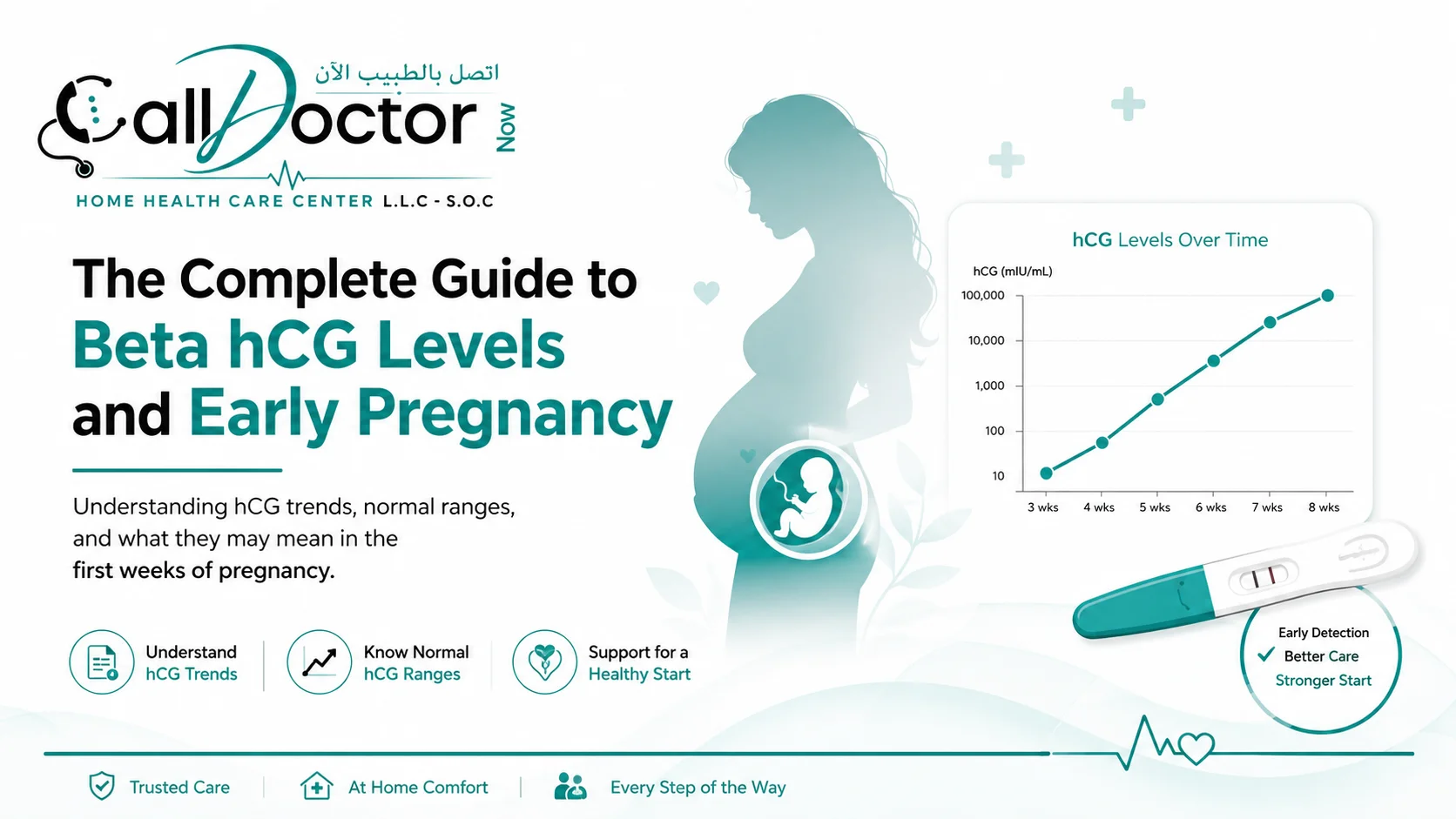
Beta hCG is the beta subunit of human chorionic gonadotropin, the hormone that confirms and monitors early pregnancy. Placental trophoblast cells produce it soon after an embryo implants in the uterine lining. A quantitative blood test measures its exact concentration in milli-international units per milliliter (mIU/mL). In a healthy early pregnancy, this level roughly doubles every 48 to 72 hours. The rising trend, not a single reading, tells clinicians whether a pregnancy is progressing.
This guide explains what beta hCG is, how the body produces it, and how blood tests differ from home urine tests. It outlines approximate normal levels by week, explains the doubling-time rule, and describes what abnormal results can indicate. All ranges are approximate and lab-dependent. A qualified clinician should always interpret your individual results.
What Is Beta hCG?
Beta hCG refers to the unique beta subunit of human chorionic gonadotropin, the component that distinguishes this hormone from other glycoprotein hormones and enables precise pregnancy testing.
The hCG molecule consists of two joined subunits, alpha and beta. The alpha subunit is identical to that found in luteinizing hormone (LH), follicle-stimulating hormone (FSH), and thyroid-stimulating hormone (TSH). The beta subunit is unique to hCG. This uniqueness gives the hormone its biological specificity. Laboratory tests therefore target the beta subunit to avoid cross-reaction with these similar hormones. That is why clinicians refer to the measurement as “beta hCG” rather than simply hCG.
Beta hCG vs Total hCG
Total hCG assays detect the whole intact molecule together with free-floating subunits. Free beta hCG, by contrast, measures only the unattached beta chains. Clinicians use free beta hCG in first-trimester screening, often alongside PAPP-A and a nuchal translucency scan. Routine pregnancy monitoring instead relies on quantitative beta hCG, which reports one precise number for tracking across serial tests.
How Beta hCG Is Produced in Early Pregnancy
After implantation, trophoblast cells secrete hCG, which sustains the corpus luteum and progesterone, keeping the uterine lining intact for a developing embryo.
The syncytiotrophoblast, the outer cell layer of the implanted embryo, releases hCG within days of implantation. Without a pregnancy, the corpus luteum normally breaks down about two weeks after ovulation. Its breakdown lowers progesterone and triggers menstruation. hCG interrupts this cycle by signaling the corpus luteum to survive. The rescued corpus luteum then keeps producing progesterone and estrogen. Progesterone maintains a thick, stable endometrium with a rich blood supply. This lining nourishes the embryo before the placenta becomes fully functional. Around 8 to 10 weeks, the placenta takes over progesterone production directly. This luteoplacental shift explains why hCG climbs steeply early in pregnancy, then declines once its role in sustaining the corpus luteum is largely complete.
Beyond the Corpus Luteum: hCG’s Wider Roles
hCG does more than rescue the corpus luteum. It shapes several processes in the first trimester.
Immune tolerance. hCG modulates the maternal immune response, helping the body accept the embryo rather than reject it as foreign tissue.
Blood supply. The hormone promotes angiogenesis, encouraging new blood vessels to form and feed the growing uterine lining.
Fetal development. In a male fetus, hCG stimulates the testes to produce testosterone, supporting early genital development.
Thyroid effect. Because hCG’s alpha subunit resembles TSH, high levels can mildly stimulate the thyroid, one reason nausea often peaks when hCG peaks.
Beta hCG Blood Test vs Home Pregnancy Test
A quantitative blood test measures the exact hCG concentration and detects pregnancy earlier, while urine tests only confirm presence above a fixed threshold.
Two testing routes exist: a blood test at a clinic and a urine test at home.
Sensitivity. Home urine tests usually detect hCG only once it reaches about 20 to 25 mIU/mL. A blood test can register far smaller amounts, sometimes as low as 1 to 5 mIU/mL. This gap lets a blood test confirm pregnancy roughly seven to ten days after conception — often before a missed period.
Accuracy factors. Diluted urine weakens a home result, so first-morning urine gives the clearest reading. Testing too early risks a false negative with either method.
Practicality. Urine tests offer privacy and an instant answer. Blood tests need a venous draw but return a measurable figure a clinician can act on.
Quantitative vs Qualitative hCG Testing
Both tests can use a blood sample, yet they answer different questions.
A qualitative test reports only whether hCG is present — a simple positive or negative. Clinicians use it for quick confirmation, much like a urine test but more sensitive.
A quantitative test instead reveals how much hCG is circulating. That value lets a clinician estimate gestational age, monitor the pregnancy’s progress, and flag complications early.
The choice follows the clinical question: confirmation calls for a qualitative test, and monitoring calls for a quantitative one.
Normal Beta hCG Levels by Week
hCG rises rapidly in the first trimester, doubling roughly every two to three days, with wide reference ranges that vary by laboratory and gestational age.
The ranges below show typical serum hCG measured from the last menstrual period (LMP). Values vary widely between individuals, so a single reading carries little meaning on its own.
| Weeks since LMP | Approximate beta hCG (mIU/mL) |
| 3 | 5 – 50 |
| 4 | 5 – 426 |
| 5 | 18 – 7,340 |
| 6 | 1,080 – 56,500 |
| 7 – 8 | 7,650 – 229,000 |
| 9 – 12 | 25,700 – 288,000 |
| 13 – 16 | 13,300 – 254,000 |
| 17 – 24 | 4,060 – 165,400 |
These ranges overlap heavily. A result of 10,000 mIU/mL could fit anywhere from week five to week seven. This overlap is why clinicians date a pregnancy with ultrasound rather than hCG alone.
The hCG Doubling-Time Rule
Doubling time is not fixed — it lengthens as levels climb.
Below about 1,200 mIU/mL, hCG typically doubles within 48 hours. Between 1,200 and 6,000 mIU/mL, doubling slows to roughly 72 to 96 hours. Above 6,000 mIU/mL, the rise slows further, and the doubling rule no longer applies.
In a viable early pregnancy, clinicians expect a minimum rise of about 35 percent over 48 hours. A slow, flat, or falling trend warrants closer assessment. If your results fall outside these patterns, you can Call Doctor Now to have serial readings reviewed.
What Abnormal Beta hCG Levels Can Indicate
Slow-rising, falling, or unusually high hCG can point to ectopic pregnancy, miscarriage, molar pregnancy, or a multiple pregnancy, requiring clinical evaluation.
An unexpected pattern never confirms a diagnosis on its own. It signals the need for ultrasound and repeat testing.
Low or Slow-Rising hCG
An ectopic pregnancy occurs when the embryo implants outside the uterus, usually in a fallopian tube. hCG then rises slowly or plateaus below the expected range. This condition is a medical emergency because the growing tissue can rupture the tube.
Falling hCG instead commonly signals an early pregnancy loss. Levels decline as the pregnancy tissue passes, often after bleeding or cramping.
Miscalculated dates can also mimic a low result, so accurate timing matters before drawing conclusions.
Unusually High hCG
A multiple pregnancy lifts hCG above singleton levels, since each placenta secretes the hormone. Even so, the overlap with normal ranges means a high figure alone cannot confirm twins.
A molar pregnancy produces markedly elevated hCG, often above 100,000 mIU/mL. This gestational trophoblastic disease involves abnormal placental tissue rather than a viable embryo.
Advanced gestational age is a simpler explanation, as hCG is naturally highest late in the first trimester.
When Beta hCG Meets Ultrasound
Once hCG passes the discriminatory zone of about 1,500–2,000 mIU/mL, a gestational sac should be visible on transvaginal ultrasound, aiding diagnosis.
hCG answers whether a pregnancy should be visible. Ultrasound shows where it sits and whether it is viable. The two tests work together.
The discriminatory zone is the hCG level above which a normal intrauterine pregnancy should appear on a scan. A transvaginal scan reaches this zone earlier than an abdominal scan, detecting a pregnancy up to a week sooner.
When hCG sits above the zone but the uterus appears empty, clinicians suspect an ectopic pregnancy or an early loss.
The threshold is not absolute, though. Newer evidence suggests a gestational sac may not appear reliably until hCG nears 3,500 mIU/mL. So a single high reading should not, on its own, trigger treatment in a stable patient a viable pregnancy can still be confirmed on a follow-up scan.
Frequently Asked Questions
1. How soon can a beta hCG blood test detect pregnancy?
A blood test can detect hCG about 7 to 10 days after conception, often before a missed period. This is earlier than a home urine test, which typically needs the level to reach 20 to 25 mIU/mL.
2. What is a normal beta hCG level in early pregnancy?
There is no single normal value. Levels vary widely at every stage and depend on gestational age and the laboratory. A non-pregnant result is usually below 5 mIU/mL, while 5 to 25 mIU/mL is borderline and needs a repeat test.
3. How fast should beta hCG levels rise?
In a viable pregnancy, hCG rises steadily in the first trimester. A single value means little on its own. Clinicians assess the trend across two tests taken 48 to 72 hours apart, not one reading.
4. Does a high beta hCG level mean twins?
Not on its own. A multiple pregnancy can raise hCG, but the overlap with normal singleton ranges is too wide to confirm twins. Only an ultrasound can confirm a multiple pregnancy.
5. Can I have a healthy pregnancy with a low beta hCG level?
Yes. A low reading may simply reflect early or miscalculated dates. Because ranges are so broad, a low value alone does not indicate a problem—the trend and an ultrasound give the full picture.
